

Work smarter with Kanban methodology
Kanban reshapes the way teams operate - from factory floors to fast-moving software organizations - through visual workflows, uninterrupted flow, and a culture of continuous improvement.
Rooted in the Toyota production system
Kanban's evolution from lean manufacturing to digital transformation is a testament to adaptive thinking across industries and generations.
1940s – Toyota, Japan
Taiichi Ohno develops the Kanban system to keep pace with American manufacturers, drawing inspiration from supermarket restocking models.
2000s – Software & Tech
Software teams adopt Kanban to eliminate bottlenecks and accelerate delivery speed throughout the product lifecycle.
2010s – Digital Tools
Platforms like Jira, Trello, and Asana bring Kanban boards online, putting visual workflow management within reach of teams of any size.
Today – AI-Augmented
Kanban advances alongside AI and digital transformation - enabling automated task routing, proactive bottleneck detection, and real-time decision support.
Six pillars that drive Kanban
These principles make Kanban universally applicable - from agile software teams to hospital workflows.
Empirical Process Control
Decisions are grounded in observation and data, not assumptions. Kanban helps organizations reduce resistance to change through ongoing, incremental improvement.
Iterative Development
Progress is made in small, deliberate steps - enabling course corrections based on stakeholder input and a deeper understanding of the workflow over time.
Collaborative Leadership
Leadership is cultivated at every level of the organization, building shared ownership, open dialogue, and a commitment to continuous learning.
Value-Based Prioritization
Work is ranked by the value it delivers to customers - keeping the focus on understanding what matters most: customer needs, business goals, and risk.
Self-Organization
Teams take ownership of their responsibilities independently - building accountability, motivation, and confident decision-making at every level.
Visualization
Kanban boards make work visible at a glance - driving transparency, surfacing areas for improvement, and supporting data-informed decisions.
Track what truly matters
Kanban metrics and reports deliver clear visibility into team performance, fueling continuous improvement across every stage of the workflow.
Key Kanban Metrics
Popular Reports
Four phases of Kanban
Kanban operates across four iterative phases, keeping teams synchronized and delivery on track.
Setup Phase Objectives
Determine Kanban Vision
Product Owners define the direction for all Kanban activities.
Create Kanban Board
Establish the backlog structure and configure the workflow.
AI-Powered Tooling
Determine AI Kanban Tool
Choose AI-enabled platforms to improve task routing and decision quality.
Plan Phase Objectives
Refine Kanban Backlog
Review, estimate, and prioritize items in the backlog.
Conduct Planning Meetings
Advance items to "Ready" status based on priority and available capacity.
AI-Powered Tooling
Automated Backlog Prioritization
AI processes data to recommend the most effective backlog sequencing.
Execute Phase Objectives
Manage Work Items
Progress tasks through each stage of the Kanban board workflow.
Monitor Flow & WIP Limits
Maintain steady delivery and prevent bottlenecks from forming.
AI-Powered Tooling
Intelligent Resource Allocation
AI distributes tasks according to team capacity and individual skill sets.
Improve Phase Objectives
Analyze Kanban Metrics
Examine cycle time and flow data to uncover inefficiencies.
Conduct Retrospectives
Drive ongoing refinement of workflow and team processes.
AI-Powered Tooling
Predictive Bottleneck Analysis
AI flags potential delays and workflow disruptions before they occur.
Who drives the Kanban system?

Product Owner
Accountable for capturing organizational needs and communicating priorities with clarity, while maintaining ownership of the Kanban Backlog.

Kanban Manager
Guides the Kanban process, oversees the board, and keeps the team aligned while maintaining continuous flow throughout delivery.

Kanban Team
Cross-functional contributors who complete tasks, collaborate on process improvements, and sustain flow efficiency day to day.

Kanban Tasks
Discrete, actionable work items assigned to team members and tracked visually as they advance through each stage of the workflow.

Task Groups
Clusters of related tasks required to deliver a specific outcome - supporting coordinated, parallel execution across the team.

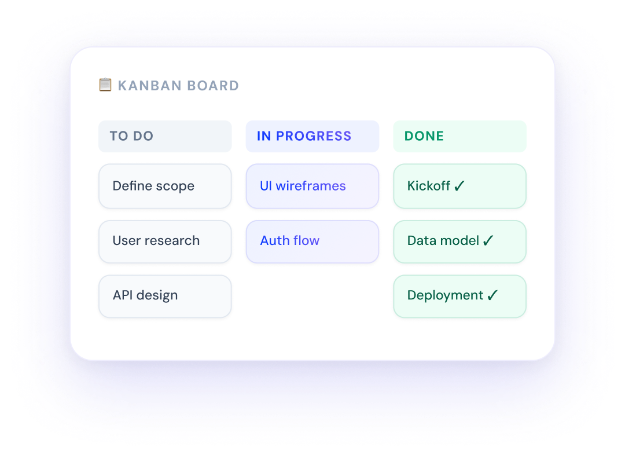
Kanban Board
The visual core of the system - organizing work into columns to monitor progress, surface bottlenecks, and keep execution on track.
Kanban works everywhere
From manufacturing to modern digital teams, Kanban adapts to fit the domain - not the other way around.