

Six Sigma
in 6 Minutes.
Six Sigma is the data-driven, customer-focused methodology trusted by the world's leading organizations to eliminate defects, cut waste, and achieve near-perfect process performance.
What is Six Sigma?
A Proven System for Process Excellence
Six Sigma is a data-driven, customer-focused, and results-oriented methodology that applies statistical tools and techniques to systematically eliminate defects and inefficiencies from any process.
Developed in the 1980s at Motorola to reduce manufacturing variation, it rose to global prominence when Jack Welch embedded it at the core of General Electric's strategy in 1995. Today, it is applied across manufacturing, construction, banking, healthcare, education, government, and IT sectors around the world.
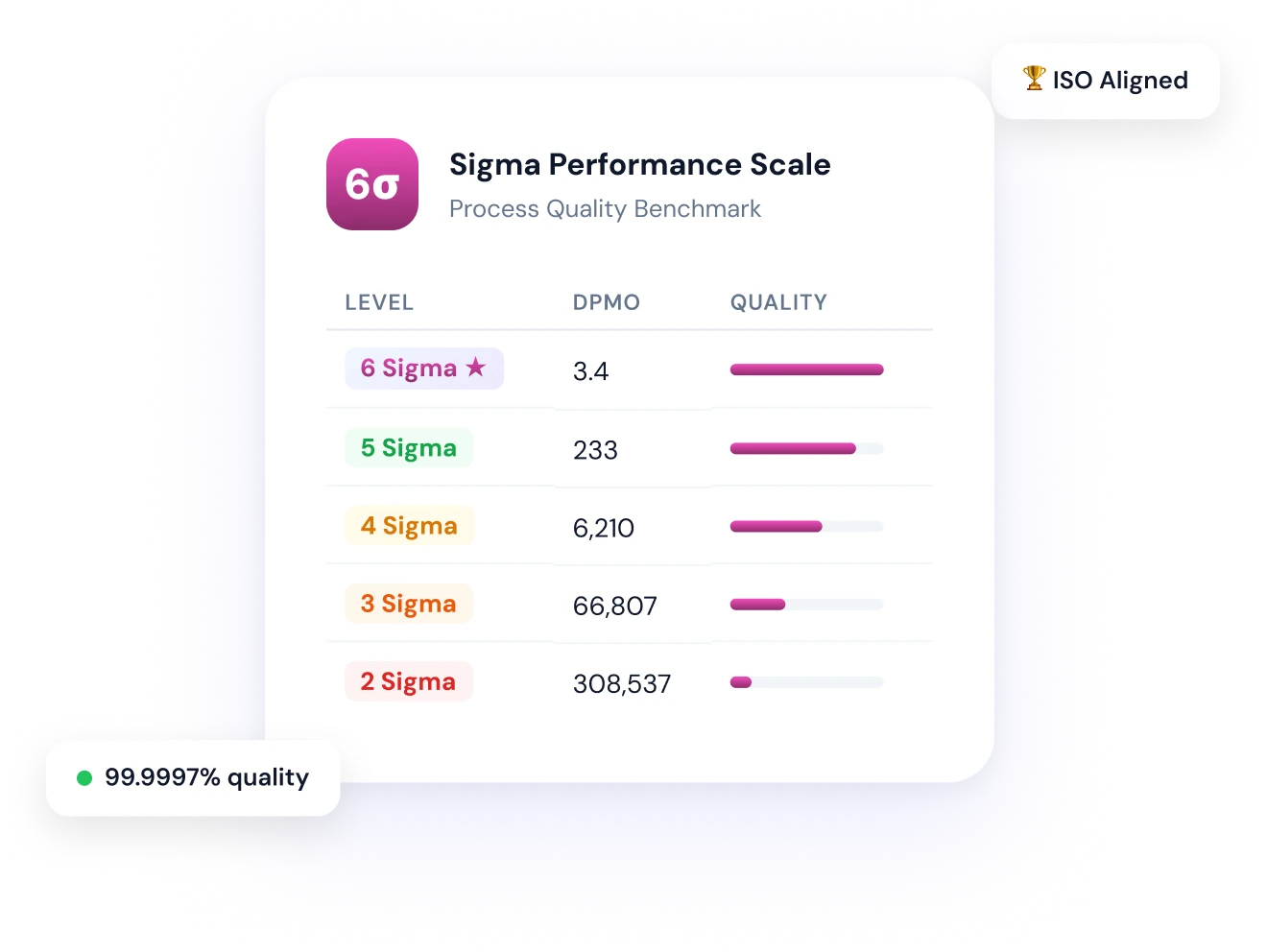
The name is rooted in statistical quality control - a Six Sigma process delivers 99.99966% defect-free outputs, which translates to just 3.4 defects per million opportunities.

Statistical Process Control
Leverages SQC to assess process capability - a numerical measure of how consistently a process meets customer specifications.

Defined Targets
Clear, quantifiable outcomes: shorter cycle times, lower costs, and stronger quality ratings.

Skilled Team Structure
Executive Leaders, Champions, Black Belts, Green Belts, and Yellow Belts collaborating at every level.
How Good Is Your Process?
A process's sigma rating reflects its yield - the share of
outputs that are completely defect-free.
| Sigma Level | Defects Per Million Opportunities | Defect-Free Output | Performance |
|---|---|---|---|
| 6σ - World Class | 3.4 | 99.9997% |
100%
|
| 5σ - Excellent | 233 | 99.98% |
99.98%
|
| 4σ - Good | 6,210 | 99.38% |
99.38%
|
| 3σ - Average | 66,807 | 93.32% |
93.32%
|
| 2σ - Below Average | 308,537 | 69.15% |
69.15%
|
Choose Your Belt Level
Each certification follows a structured sequence of phases with clear,
measurable targets - from foundational awareness to expert practitioner.


How Six Sigma Works
Every Six Sigma project follows a structured 5-phase framework designed to deliver
measurable, lasting improvement.
Define
Clarify the problem, customer needs, and project objectives
Measure
Gather data to establish the current process baseline
Analyze
Pinpoint root causes of defects through statistical analysis
Improve
Design, pilot, and implement solutions that target root causes
Control
Lock in improvements with controls and ongoing monitoring systems
Applied Everywhere
Six Sigma has far outgrown its manufacturing roots. Today it drives operational excellence across nearly every industry.

Manufacturing
Cut defects and process variation on the production floor

Healthcare
Elevate patient outcomes and optimize clinical workflows

Banking & Finance
Reduce errors across transactions, lending, and compliance

IT / ITES
Continuously improve software delivery and service quality

Construction
Tighten project schedules and reduce costly rework

Education
Strengthen learning outcomes and institutional performance

Government
Deliver public services more efficiently with fewer errors

KPO / BPO
Build consistency and precision across outsourced operations